







Caitlin Starling’s fourth novel, The Starving Saints, is packed full of everything you’ve come to expect from this author: atmosphere for days, queer women being awful (complimentary), body horror, unpleasantly small spaces, and extreme acts of fealty.
Trapped in a besieged castle, with two weeks’ worth of rations remaining, the people of Aymar are waiting for a miracle. They’ve already had one, when the heretic witch Phosyne purified the castle’s water, using methods that remain mysterious even to her. But water isn’t enough to sustain the siege’s survivors, and the king demands that Phosyne now find a way to create food out of nothing. To ensure that she’s working as hard as she can, he assigns his most reliable knight, Ser Voyne, to watch over Phosyne’s progress. A third POV character, the servant girl Treila, prowls the castle doing an illicit trade in rats and plotting her revenge against Ser Voyne for executing her father five years ago.
This premise, obviously, rules. I love it when people are stuck together in places they can’t leave: bottle episodes, generation ships, boarding schools. I get a little frisson of pleasure every time I remember the moment in The Thing where Kurt Russell says, “Nobody trusts anybody now, and we’re all very tired.” Nobody in Aymar Castle trusts anybody now, and they’re all so, so, so very tired. Cut off from her former beliefs, Phosyne can’t even attend the Priory church services where everyone else gets to taste a precious drop of honey as sacrament. Her miracle with the water has been attributed to the Priory (her former religious order) out of fear that the castle’s inhabitants wouldn’t trust the cisterns if they knew Phosyne was the one who purified them. Ser Voyne’s presence in Phosyne’s workshop is intended as further incentive, as if there could be any stronger incentive than Phosyne’s own death and the deaths of everyone within Aymar’s walls.
As Aymar waits for relief from outside their walls or the miracle of restored food within them, a different wonder appears. Their god, the Constant Lady, appears inside the castle gates, flanked by three attendant Saints. Nobody opened the gates to let them in. They did not fight their way through. They simply appeared, and they have brought with them gifts, rich banquets of fresh food to a starving populace. Though a few protest that it’s too good to be true—Prioress Jacynde for one, the ever-suspicious Treila for another—the castle’s inhabitants are too hungry to ask questions, and soon they are all under the sway of the (presumed) Constant Lady.
Buy the Book
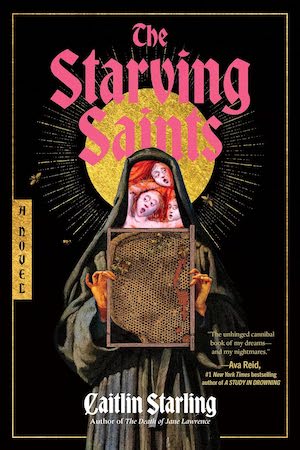
The Starving Saints
The Starving Saints is a book about the allures, and then the price, of desire. All three of our main characters recognize the dangers posed to the castle by the (supposed) Constant Lady. Yet they’re still terribly vulnerable to the temptations of the Lady and her Saints, as soon as they’re offered a quick path to the thing they most desire. For Phosyne it’s knowledge; for Treila, justice; for Ser Voyne, a righteous cause to serve. They are not wrong to have these wants, not even necessarily wrong to depart from prevailing moral norms in their pursuit of them. But what the Lady offers is the ends without the means. This is a book that argues for the intellectual and moral work that goes into attaining what you want. When our characters fail to think critically about what they’re doing, when they stray too far from the moral calculus that takes other people’s lives into account, that’s when they’re most susceptible to falling into abusive and destructive acts.
Nuns (and other trappings of Catholicism) are having a bit of a moment in SFF (and, I suppose, more broadly in the culture, what with getting a new Pope right on the heels of the release of Conclave last year). Lina Rather, Meredith Mooring, Tamsyn Muir, and Gabrielle Buba have all written books that explore the tensions that arise when you live within a patriarchal power structure that teaches the value and method of pursuing moral truth, yet demands that its adherents ignore any truths that fall outside of an approved set of conclusions. These are themes I love and adore. I want to bathe in these themes. I want to do a keg stand where I chug so much of these themes I end up in the hospital with theme poisoning.
The Starving Saints… eh, doesn’t so much. Starling keeps taking the bite out of her moral dilemmas before they have a chance to get started. Before the Lady and her Saints arrive, the castle’s leaders discuss the need for cannibalism, which (spoiler) does happen later on, in far more gruesome excess than the king had proposed. This is a major taboo, and it should feel like an urgent moral matter for the characters to grapple with. But Ser Voyne, the main voice speaking against the cannibalism-for-survival plan, has eaten human flesh before, when “they [were] pinned down in bleak winters, in blighted fields… But that was different.” We later find out that Treila has also done cannibalism in the past. In a setting where two of our three protagonists (!) have eaten human meat to survive, it’s hard to feel that a major boundary will be crossed if the inhabitants of Aymar Castle have to do it again now.
For a book about gods false and true, The Starving Saints shows little interest in its characters’ religious faith. Treila, Phosyne, and Ser Voyne all have to grapple with the inadequacies of the moral frameworks they’ve been operating under. Yet this happens almost entirely without reference to the dominant religion, even though the Priory is supposed to be a vital organizing principle of this society. We don’t get a clear explanation for why Phosyne’s new research was so incompatible with the Priory. It’s not even clear what the Priory itself believes, although one gets hints now and then. Phosyne has lost her faith so completely that she can’t remember what it was like to have it, yet the question “faith in what?” remains uncertain. In the Constant Lady, who we later learn even Prioress Jacynde doesn’t believe cares about her flock? In the alchemical and scientific research methods the Priory teaches? Something else?
Still, Phosyne’s frantic, messy research spoke to me, not least because it’s clear that she’d be doing it whether the community was starving to death or not. She doesn’t want to die, obviously, but the main thing she wants is to know. The book distinguishes between the Priory’s methodical alchemy and the intuitive, bargaining, elemental magic Phosyne is struggling to discover:
This is how the learning works: side-glimpsed realizations, nothing direct, but always leaning toward greater understanding… If Ser Voyne was here, there’s no way Phosyne could explain it in a way that makes sense, but it does. It does.
As the book proceeds, the reader also begins to catch side glimpses of how the magic works, and how the castle might be saved. The (apparent) Constant Lady and her Saints are old, and dangerous, and they don’t operate on morality, but on bargains and elemental balance—and it’s perhaps no surprise that the rigidly religious and scientific Priory is unequipped to deal with it when it arrives. If Shirley Jackson had written Game of Thrones, I like to imagine that The Starving Saints is what she’d have produced. It’s a meaty, troubling novel with even more cannibalism than its description led me to expect. I reiterate that at least two, probably all three, point-of-view characters have known the taste of human flesh, and you know for yourself if that’s something you’re into. God forbid women do anything.
The Starving Saints is published by Harper Voyager.

Almost sounds as if Caitlin Starling is channeling Clive Barker, specifically his Cenobites.
And now I have another book to add to me TBR pile.
This book was beautiful chaos. I highly recommend it.